This Post by Hartzell Air Movement should be part of all engineer and end user fan and blower design and implementation practices. As sales associates for Hartzell Fan Products and Explosion Prevention manufacturers, we too often encounter an incomplete understanding of spark resistant construction and explosion prevention in hazardous environments where fans are in use.
Where materials are handled in or out of the airstream that are known to be explosive (including combustible dust) safe maintenance procedures must be dictated as small motors used in hand tools, portable vacuums, etc., could generate an ignition spark.
At SysTech, we must have all airstream constituents and ambient environment information before making a fan selection.
Two Hazards, Two Answers
"Explosion Proof" fans and "Spark Resistant" fans, while seemingly related, take care of different things. If you need to determine whether you need spark resistant construction, an explosion proof motor, or both, read on.
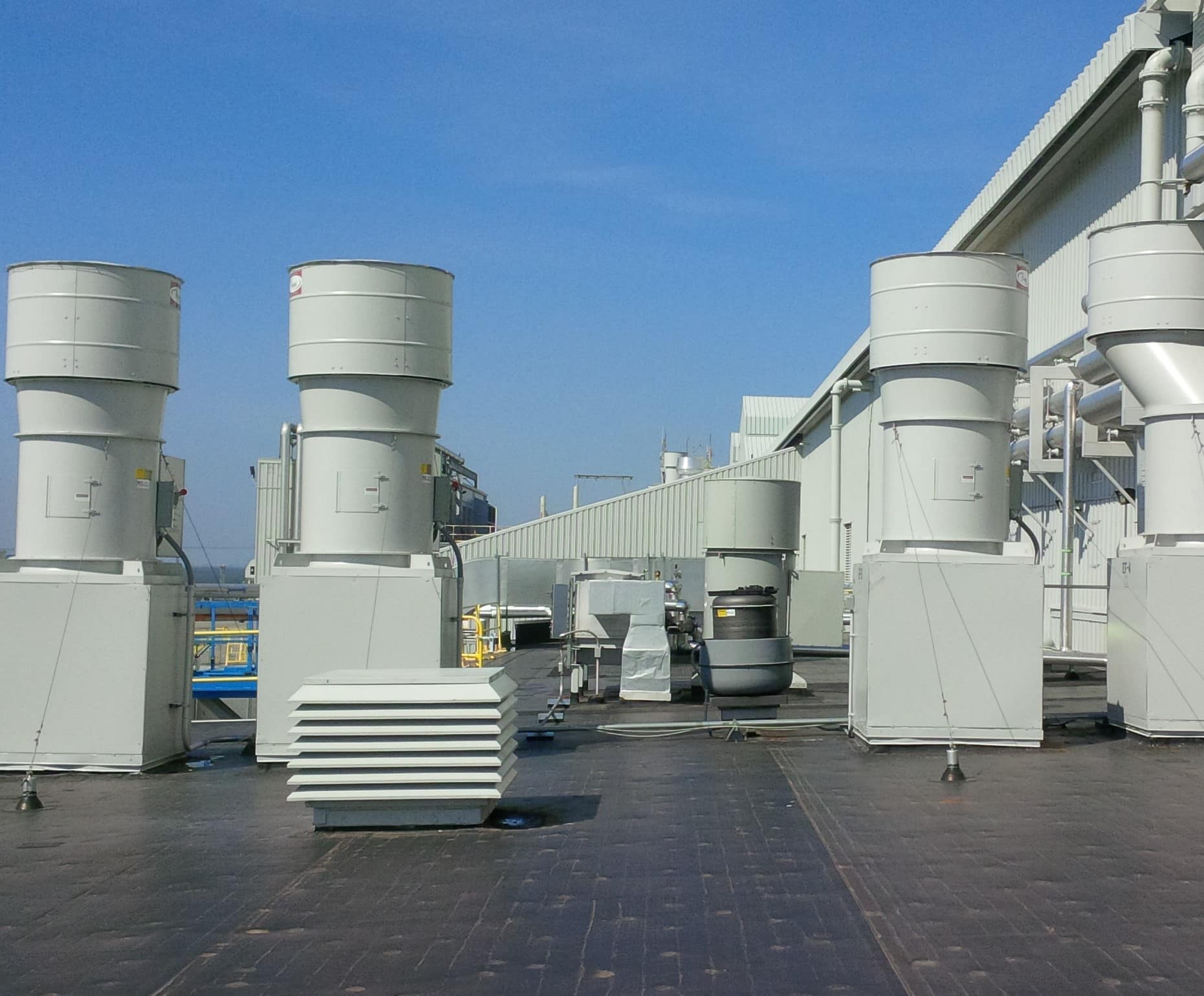
Visualize the paint booth exhaust in this photo. It carries solvent-based air through the fan wheel; the motor, drive, and controls take up the rest of the space, which might have its own vapor hazard. These are not the same.
First, there could be an ignition source in the airstream, such as a rubbing wheel or a static spark, producing a flame.
Second, there could be a source of potential sparks in the air near the equipment: an arcing contact or hot motor housing might start a flame.
SPARK RESISTANT construction takes care of the first. EXPLOSION PROOF electrical equipment takes care of the second. A single phrase in the specification that covers both leaves the vendor guessing what you really wanted.
Why a fan cannot be explosion proof: Explosion proofing prevents an internal ignition within an enclosure from traveling out into the surrounding atmosphere. A fan moves the outside atmosphere through the motor and fan housing; it has nothing to contain, it is simply pulling the atmosphere through it. That is why the motor and electrical package can be, and should be, rated for a hazardous location.
| Spark Resistant | Explosion Proof | |
|---|---|---|
| Hazard | Ignition in the airstream | Ignition in the ambient |
| Governing reference | ANSI/AMCA 99-25, Sec. 8; ASTM D4167 for FRP | NFPA 70 (NEC) Articles 500 & 505; UL 1203 |
| Engages for | Wheel, housing, inlet, shaft opening | Motor, starter, controls, wiring |
| Mechanism | Material pairing and fortification that repels ferrous strikes; conductivity on FRP | Enclosure contains an internal ignition so that it cannot escape |
Inside the Airstream: ANSI/AMCA Standard 99-25
The Air Movement and Control Association defines "Spark Resistant Construction" in Section 8 of ANSI/AMCA Standard 99-25 in the group's Standards Handbook. Fans are classified into three construction types depending on how likely it is that a mechanical motion will bring ferrous parts into contact.
Type A
Most severe. Every fan part that faces the flow of air is made of metals that don't contain iron.
Type B
Nonferrous wheel and nonferrous ring at shaft opening. Ferrous hub and shaft allowed if no shift is sufficient to cause contact and/or rub.
Type C
The baseline. The fan is so arranged that a shift of the wheel cannot make two ferrous parts touch each other.
You should take a good look at the notes accompanying the standard. "Nonferrous" specifies that the material can contain no more than 5 percent iron unless otherwise demonstrated to be spark resistant, so stainless steel does not qualify just because it has corrosion resistant properties. The standard clearly states that its construction types are not a guarantee of safety and can't prevent ignition following a catastrophic failure or from material in the airstream.
Do not put bearings, drives, and electrical equipment in the airstream unless designed or enclosed so that their failure will not ignite it.
The choice of materials in a pairing, say, an aluminum wheel in a severely corroded steel housing, matters: research by the US Bureau of Mines has shown that a combination like this can produce a spark capable of ignition.
Around the Equipment: Hazardous Location Codes
Explosion proof is an electrical issue, and it comes from a different set of writings entirely. The National Electrical Code (NFPA 70) splits the hazardous locations of Article 500 into Class (explosive gases and vapors, combustible dusts, and ignitable fibers) and Division, and the Code's zone system in Article 505 exists as an alternative. UL 1203 checks for explosion proof (and dust-ignition-proof) electrical equipment, and OSHA 29 CFR 1910.307 brings hazardous locations into the Federal OSHA regulations at the workplace.
After a room has been classified, the motor, starter, and wiring need to be listed for that Class and Division. None of that affects what happens at the fan wheel.
How are codes used? Process codes vary from user to user, and one or many can apply to a specific application. Related codes that sit between the two typically require both, such as:
NFPA 91: Exhaust systems which handle vapors, gases, mists, and particulate solids.
NFPA 33: Spray finishing use, such as the paint booth above, including fan construction.
NFPA 652 and 654: Basic combustible dust hazard analysis.
Check the editions your authority having jurisdiction has recognized.
The Fiberglass Exception
The AMCA types are built around ferrous and nonferrous parts, which is consistent with steel and aluminum fan types. When an FRP fan is in question, it becomes a different matter. There are no ferrous parts in the airstream, so there is no strike potential. However, FRP is an insulator, and static charge can develop on all the surfaces contacted by the air.
A discharge in a flammable airstream is exactly what you don't want, and ASTM D4167, the standard specification for fiber-reinforced plastic fans and blowers, addresses this issue by making the wheel and housing electrostatically conductive by way of a carbon-dense conductive coating on airstream interior surfaces and grounding straps that connect the housing to the steel base.
Specify D4167 conductive construction on fiberglass exhaust fans installed in corrosive atmospheres where flammable vapors are present, and take the same precautions with any FRP damper placed in the duct run. Don't forget to ground the fan base per the installation instructions.
Best Practices for Fan & Blower Selection in non-clean air or questionable environments
-
- Spell out the characteristics of the airstream. Note the material, either dust or vapor, its concentration if known, its temperature, and any moisture.
-
- Specify fan construction. Metal fan: AMCA 99-25 Type A, B, or C. FRP: ASTM D4167 conductive construction.
-
- Area classification. Specify the classification on its own. List the NEC Class and Division or Zone, and the motor and electrical rating required.
-
- Include corrosion stipulations. Remember to factor in the airstream and the surrounding air, because material choices limit which spark resistant types are available.
-
- Fan base grounding. Indicate the party responsible for grounding the fan base in the work scope.
Leaving spark resistance out of a fan or Blower selection does not remove the hazard; it just moves that decision to whoever builds the fan. SysTech checks out the airstream on every fan selection, whether you've got a dust-collector centrifugal fan or an industrial fan or blower in a finishing line, so the construction is right for what the fan is going to be moving.
Are you unsure about whether you need spark resistant construction, an explosion proof motor, or both? Send SysTech your airstream configuration and we will help you select it properly the first time.
Call SysTech: 800-456-9460References
ANSI/AMCA Standard 99-25, Standards Handbook, Section 8: Spark Resistant Construction. An Air Movement and Control Association International, Inc. Publication.
ASTM D4167, Standard Specification for Fiber-Reinforced Plastic Fans and Blowers. ASTM International, Committee D20.
NFPA 70, National Electrical Code, Articles 500 and 505. National Fire Protection Association.
NFPA 91, Standard for Exhaust Systems for Air Conveying of Vapors, Gases, Mists, and Particulate Solids.
NFPA 33, Standard for Spray Application Using Flammable or Combustible Materials.
NFPA 652, Standard on the Fundamentals of Combustible Dust; NFPA 654, Standard for the Prevention of Fire and Dust Explosions from the Manufacturing, Processing, and Handling of Combustible Particulate Solids.
UL 1203, Explosion-Proof and Dust-Ignition-Proof Electrical Equipment for Use in Hazardous (Classified) Locations.
OSHA 29 CFR 1910.307, Hazardous (Classified) Locations.