Industrial facilities that handle combustible dust face one critical fact: industrial safety. When handling combustible and metal dusts, wet dust collectors or wet scrubbers offer unmatched advantages where safety, compliance, and long-term performance are the priority.
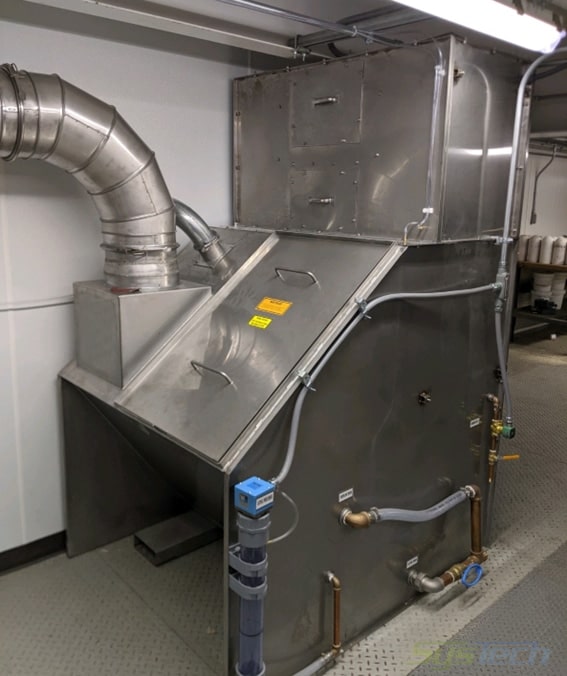
Wet Collector System in a Manufacturing Environment
When to Choose a Wet Dust Collection System
Most industrial dust collectors are of the dry type and offer explosion protection for the majority of dust types. However, certain dust demands a wet dust collector for safety and compliance. Wet scrubbers are specially engineered to neutralize combustible dust by capturing and submerging particles in atomized water.
Wet dust collector systems are especially recommended in key scenarios such as:
- Combustible Metal Dusts: If your process generates dust from metals, wet collection is often the required approach. Recent editions of NFPA 484 explicitly require wet-type collectors for many metal dust processes.
- Processes with Sparks or Ignition Sources: Even with non-metal dust, any operation prone to frequent sparks or embers may favor a wet scrubber.
- Code and Insurance Requirements: Beyond NFPA 484 for metals, general combustible dust standards (NFPA 652 and NFPA 654) and OSHA’s National Emphasis Program require a documented Dust Hazard Analysis (DHA) and adherence to recommended controls.
- Mixed Materials: Dusts that are a combination of metal and wood particulates require a specific approach, often best addressed with wet collectors.
- Material Make-Up: In cases where the particulate being collected is already wet, wet scrubbers are the most suitable solution.
Deconstructing the Explosion Pentagon
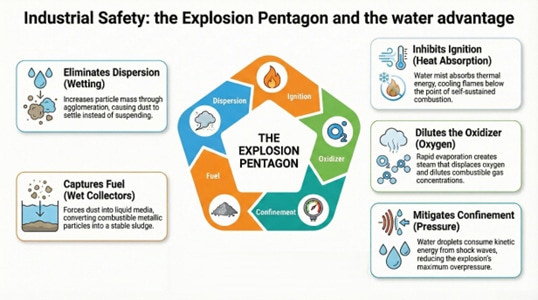
Combustible dust explosion incidents are driven by five elements known as the “Explosion Pentagon.” For a dust explosion to occur, all five elements must be present simultaneously:
- Fuel (combustible dust): Can come from metals, wood, food ingredients, and more.
- Ignition Source (spark, heat, static)
- Oxidant (air/oxygen)
- Dispersion (dust suspended in air)
- Confinement (enclosed space)
Wet dust collectors mitigate each component of the dust explosion pentagon in the following ways:
- Fuel: Moisture increases the Minimum Explosive Concentration (MEC).
- Ignition Source: Atomized water absorbs thermal energy and lowers the likelihood of reaching the Minimum Ignition Energy (MIE).
- Dispersion: Wet systems capture dust at the source and convert it into a non-dispersible slurry.
- Confinement: Water droplets absorb energy from shock waves, reducing the explosion’s maximum overpressure.
- Oxidizer: Rapid evaporation displaces oxygen and dilutes combustible gas concentrations.
Benefits of a Wet Dust Collector
| Criteria | Wet Dust Collector |
| Spark Management | Low risk: atomized water captures and neutralizes explosive metal dust |
| Secondary Explosion Risk | None: dust is stabilized in slurry, minimizing ignition sources |
| Particle Size Sensitivity | Water saturation raises MEC; even fine dust becomes inert |
| Compliance Burden | Easier NFPA/OSHA alignment for explosive dust |
How Does a Wet Dust Collector Work?
A wet dust collector works by drawing dust-laden air into a chamber where it meets atomized water. The dust and any sparks are immediately captured and neutralized, forming a wet slurry. Cleaned air is then passed through mist eliminators and safely exhausted or recirculated. The remaining slurry settles as sludge, which is periodically removed and is safer to handle than dry dust.
Ideal Applications for Wet Scrubber Dust Collectors
Industrial wet dust collectors are ideal for environments where combustible dust is generated by grinding, cutting, polishing, or finishing metal-based materials. Examples include:
- Aluminum grinding and polishing
- Magnesium machining
- Powdered metal production
- Titanium sanding or cutting
- Welding and thermal spray operations
Contact us to review your application and determine whether a wet collector device is the safer, smarter option for your facility.